Website Redesign ROI: A Simple Model To Decide if 2026 Is the Year
Sure, your website works, but if it’s not adding zeroes to your San Diego business, it’s expensive.
Why stick with your subpar site when some needle-moving tweaks here and there can turn it into a profit-churning machine? If you’re wondering whether or not 2026 is the year for a site facelift, here’s our website redesign ROI guide to make your decision-making easier.
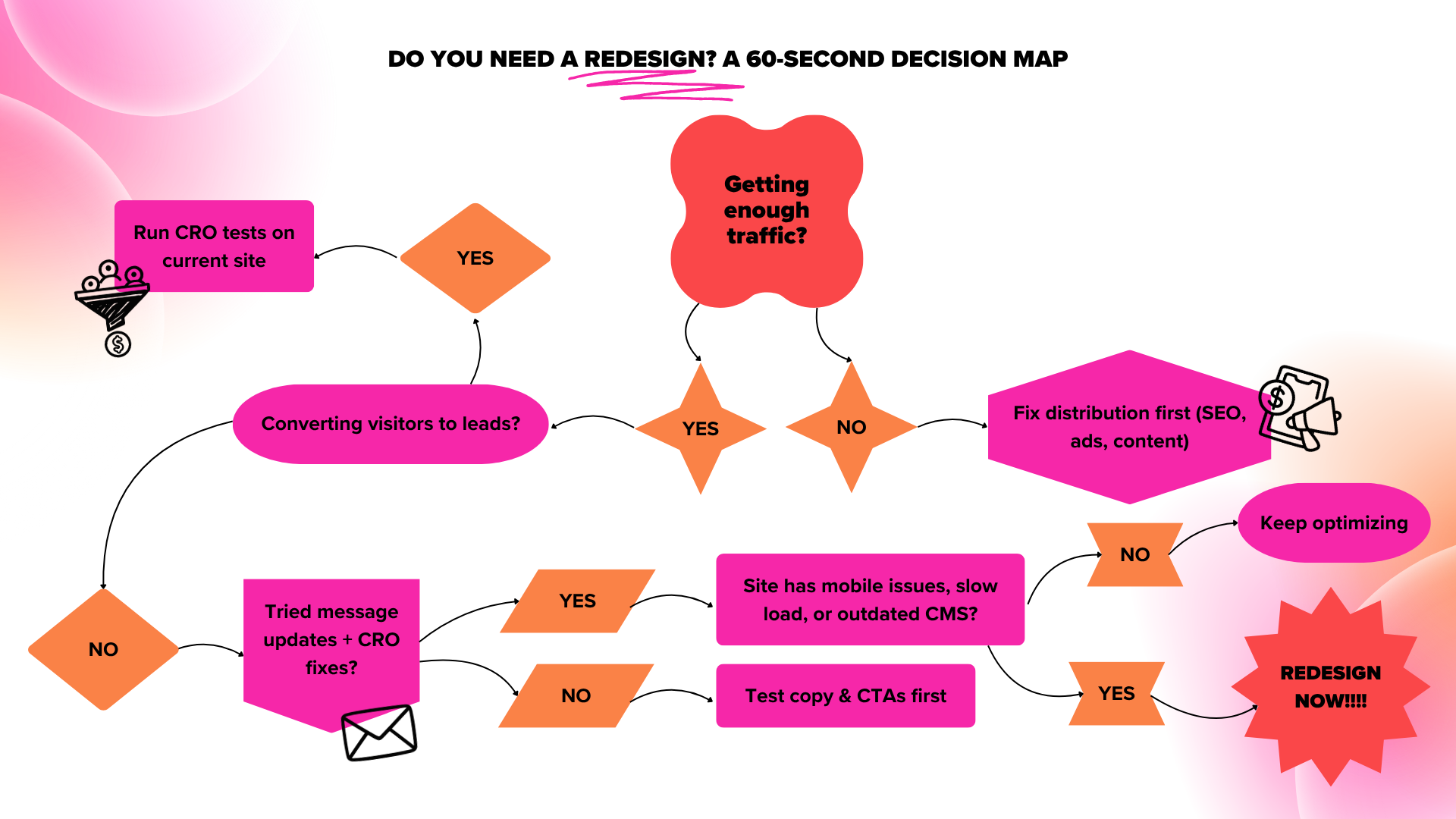
First: Do You Actually NEED a Redesign or Just Better Messaging and CRO?
You might not need a new site. Before you act on our business case for redesign, zero in (first) on what doesn’t work and start front there.
Your Messaging
Sometimes, it’s just how clearly you position your offer. If you’re getting enough clicks but none of the conversions to show for it, do these:
- Find out which parts of your site gets the most traffic, and write your offers there (clearly and simply).
- Position the right messages in the right places (From top to bottom: service and target audience, then pain point, then CTA).
- Clear up and tighten the CTAs (“Call now” beats “Learn more” any day).
CRO
Does your messaging already tick the boxes? Maybe there are too many challenges between the message and the next step.
Make life easier for your site’s users with:
- Reviews
- Easy-to-fill and easy-to-find forms
- Buttons with the CTA and offer
These conversion rate optimization tweaks can already be enough for the conversion rate lift you’re after.
When the Two Fail = Website Redesign
Once you’ve A/B tested your website after optimizing your messaging and CRO, and neither moves the needle, it’s time for a website redesign.
However, when you’re giving your site an upgrade, you need to do so in the right places.
- If more people leave your site after visiting a page: Eliminate anything on your site’s layout that makes its time-to-first-byte slower (like bloated media or cluttered layout).
- If you get web visits but high site exits from mobile users: There’s a problem with your site’s mobile responsiveness. On your CMS, optimize your site layout for mobile devices, so it looks good on both phones and on desktop.
If your site has had the same look for years: Whether it’s due to a dev backlog or just you liking how your site looks, a site layout update is necessary, especially after the two-year mark.
The ROI Model (Numbers Over Vibes)
Run this formula before you spend a dime on a redesign.
- Current monthly visitors: Pull this from GA4 or Google Search Console. The traffic you already have matters more than the traffic you hope to attract.
- Current conversion rate (CVR) on money pages: Calculate how many visitors become leads on your contact, pricing, or service pages.
- Close rate from qualified leads to deals: Not every inquiry closes. Track the percentage of leads that become paying clients.
- Average deal value or LTV: What’s a customer worth over their lifetime? Look at average contract size for one-time projects.
- Expected CVR lift after redesign: Most focused redesigns deliver a
27 to 50% relative improvement. A 0.8% conversion rate could climb to 1.2%. With copy tweaks and CRO work alone, you’re looking at
at least 10%.
Need to see how the math plays out?
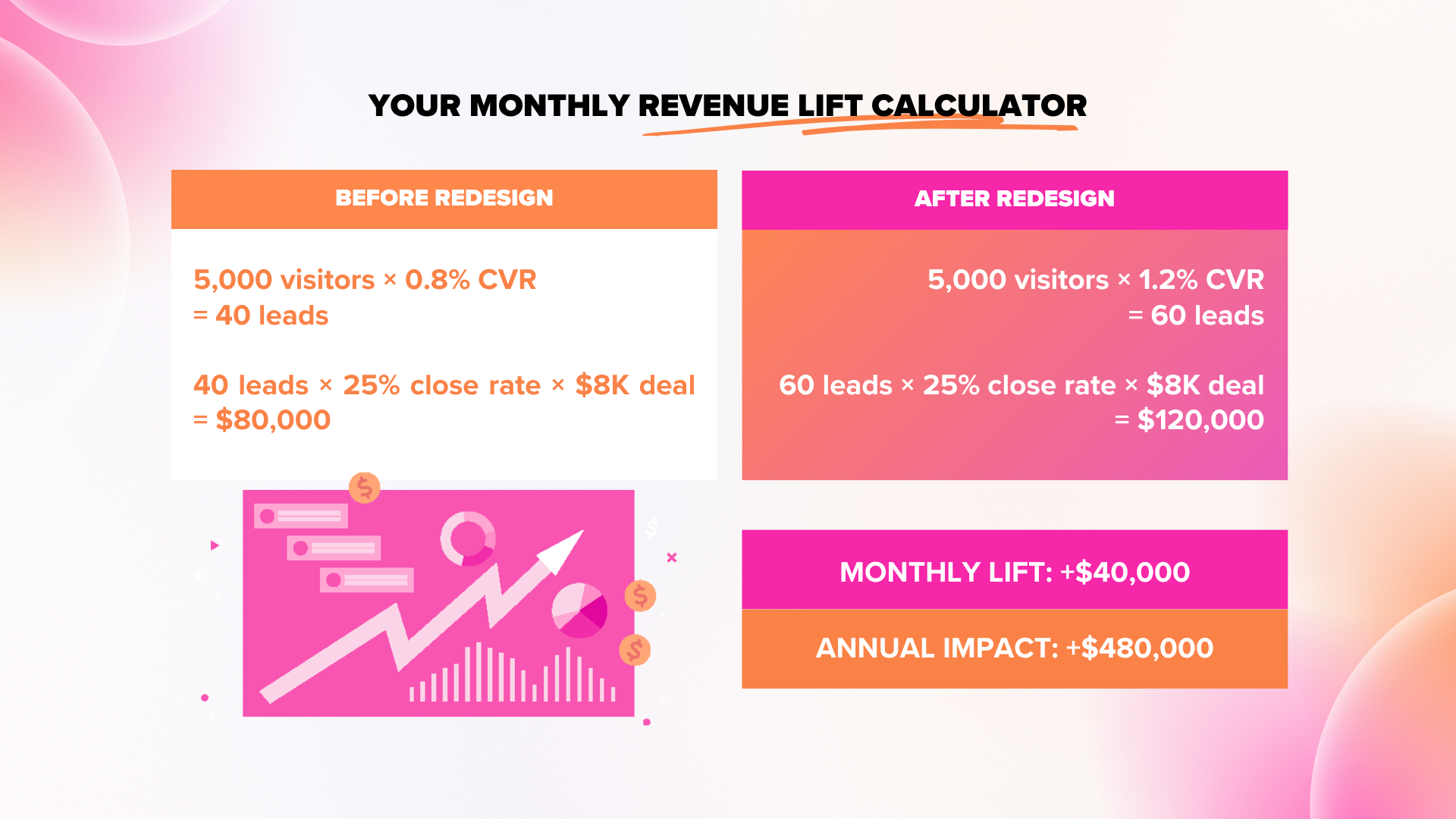
Five thousand monthly visitors at 0.8% CVR produces 40 leads. Increase that rate to 1.2% and you generate 60 leads instead.
A 25% close rate at $8,000 per deal adds $40,000 to monthly revenue. As you can see, the redesign pays for itself in weeks.
Website Redesign Cost in San Diego: Scope Matters
Are you sold on the potential website redesign benefits? Let’s talk about costs. Forget itemized breakdowns, and think in terms of web design pricing brackets in the city.
The $4K to $8K Band: Focused Professional Sites
This range works for boutique firms with five to seven core pages. You get:
- Strategy and wireframes built around branding
- Copy that converts
- Custom design
- Technical SEO
- Mobile performance optimization
- Analytics
However, you don’t get custom applications, complex e-commerce builds, or large-scale third-party migrations.
The $10K+ Band: Complex Builds
Cross this threshold when your needs expand beyond basics.
The reasons include:
- Layered information architecture
- Gated resource libraries
- Multilingual support
- Advanced animations
- Headless CMS setups
- Custom integrations
- Structured content models.
These features require significant development hours. However, you can bet that these support how your business operates and converts.
Copy Leads Design (Not the Other Way Around)
We’ve said it before and we’ll say it again: copy-first, aesthetics second. Before our designers touch anything, we plan around your messaging, and determine what kind of content will benefit certain parts of your site.
We include the following content pillars in the planning:
- Pain/fit headline with POV: These tell visitors they’re in the right place immediately.
- Value stack and outcome-led benefit blocks: These sell the transformation, not your product.
- Specific proof: These include client logos, quantified results, and testimonial clips. “Increased portfolio value by 22% in 18 months” beats vague “five-star” praise.
- Friction-free CTA: You want to provide one clear action. Book a call, download a guide, or view pricing are all good options.
- “For / not for” qualifiers: Tell people who you serve and who you don’t.
- FAQ that kills objections: Answer the questions that stop people from booking.
Here’s how all this pans out.
Take a wealth advisor’s service page. The headline addresses the pain: “Retirement planning for physicians who want control, not cookie-cutter portfolios.”
The for/not for section clarifies fit: “For physicians earning $300K+ who want active involvement. Not for early-career professionals still building emergency funds.”
Proof sits right below: three physician testimonials with specific outcomes and portfolio growth percentages. The FAQ section handles questions and objections like:
- “Do I need to move all my assets?”
- “What’s your minimum investment threshold?”
Conversion Infrastructure You Can’t Skip
Every module on your site should earn its place by moving someone closer to contacting you.
1. Offers and Pathways
Your primary CTA books the call.
Your secondary options give hesitant visitors another step, like:
- Downloading a guide
- Viewing a case study
- Checking pricing or plans
2. Easy-To-Find-and-Fill Forms
Progressive fields reveal themselves as someone fills out the form. Add “takes 30 seconds” near the submit button. A testimonial or client logo right next to the form helps.
3. Navigation That Directs Readers
Fewer top-level items mean clearer choices. Structure yours around:
- Services
- Case Studies
- Pricing
- Process
- Resources
- “Contact Us”
4. Trust Cues
Policy pages, accessibility basics, payment security logos, and certifications belong in the footer. They may not drive conversions, but without them, you’re not winning any prospects over.
What San Diego Buyers Expect Before They Contact You
The San Diego scene is competitive but more so for certain niches. These include:
- Legal firms
- Professional services
- Home services
- Creative services
- Health practices
If your business is in these industries, know that buyers research before reaching out, whether you’re in the city or outside the state.
As a local digital marketing partner, we’ve seen it all.
Clients want real photos. They’re also more likely to check which neighborhoods you serve without wading through generic service area pages.
You have to prove you serve locally and understand the market. To do this, show local credibility without turning your site into a directory listing.
For instance, a Hillcrest dentist benefits more from mentioning UTC and La Jolla than from vague “greater San Diego area” language.
How To Stay in Control
Give a designer full rein and disappear for months, and you’ll get a site you might not recognize. Stay in control by doing the following.
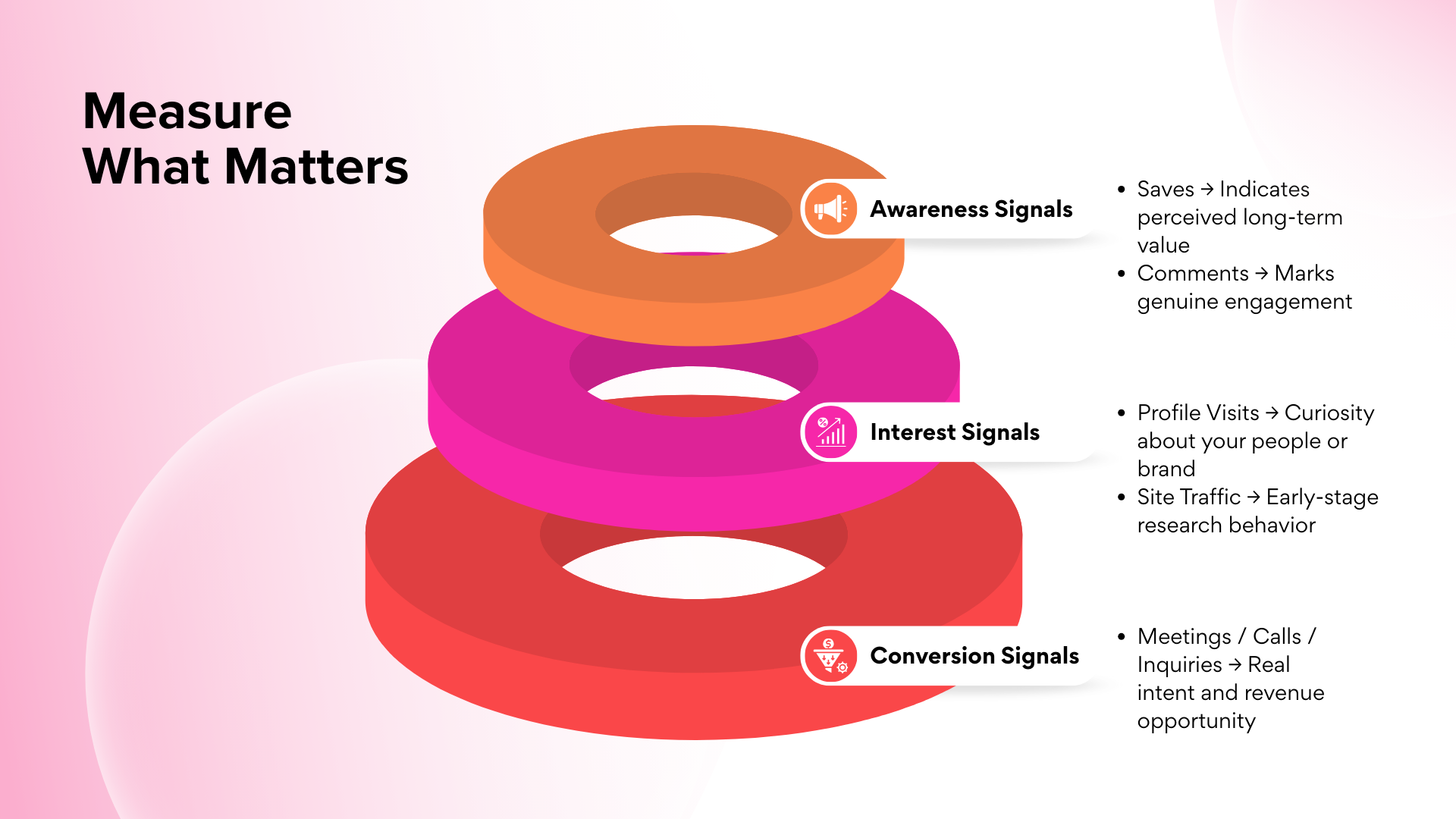
Let’s be honest. You want more out of your LinkedIn thought leader ads. What you really want is to move your business forward. So you’ll want to keep an eye on metrics that tie to your pipeline.
These metrics are:
- Saves: Why else would readers save your content or account if they don’t see long-term value?
- Comments: These are signs of genuine interest and go a step above “likes.”
- Profile Visits: You know your LinkedIn brand is making waves when it’s getting curious users to check it out.
- Site Traffic: Your thought leader ads and content are doing their jobs when your site sees a lift in its traffic.
- Calls, Meetings, or Inquiries: Can you say “converted lead?” These behaviors show that your ads and content were enough to drive action.
Over time, you’ll see patterns surface. There will be specific topics and formats that spark more of the above-mentioned actions.
Leverage content ideas and formats that click, and you’ll steer readers down your sales funnel.
Control What You Can, and the Results Take Care of Themselves
When you lean into the parts of your LinkedIn thought leader ads you can control, you’ll determine the right audience and keep them hooked with the content and formats.
But remember, your ads will only be as good as the content they’re promoting. So dial in your thought leadership posts before hitting “promote.”
We get it if you need that extra “oomph” in your thought leadership. Get a consultation today and see how we’ve helped brands solidify their LinkedIn presence.
FAQs
Can I Edit My Post Once It’s Live as a Thought Leader Ad?
You can’t. Once your post goes live, it’s locked.
What Can I Control?
You may not be able to edit your post in the Campaign Manager, but you can control who sees your posts. Also, you’ll still be able to plan your timing, budget, and even the frequency of your ads.
What Metrics Should I Focus On?
Skip the vanity metrics. The metrics that matter are saves, thoughtful comments, profile visits, and site traffic.
Can the CEO Post and Promote Content?
Sure. But know that there are other people who can like employees in your business. Just make sure they can commit to regularly posting and engaging with readers.
Do Results Happen Overnight?
They don’t, but you will see an uptick in your engagement rates when you regularly post and promote content. Play your cards right, and you might even see higher site traffic.
The key is to be consistent and control what you can.