

Executive Ghostwriting on LinkedIn: How Founders Scale Visibility Without Losing Voice
As you embark on your LinkedIn thought leadership journey, there’s a chance that your ideas outnumber whatever content you’ve posted. If this is the case, time is likely your main bottleneck. More specifically, there’s too much to write about but not enough time for you to put those industry-shaking insights on paper.
So, what do you do?
When time is in short supply, you’ll need another you to do the writing: a LinkedIn ghostwriter.
Think of executive ghostwriting on LinkedIn as a way to scale your presence without actually doing the scaling yourself. With it, you’ll be able to promote your personal brand on the platform as you generate insights with another writer.
Now, you might be wondering:
“Won’t B2B content ghostwriting cramp my personal style?”
Fear not. Here’s how other founders have delegated their thought leadership writing without sacrificing their style and brand voices.
What Executive Ghostwriting Actually Covers
One of the biggest misconceptions we hear is that ghostwriting and copywriting are the same kind of animal — but make no mistake.
While copywriting sells, executive ghostwriting promotes insights on behalf of someone else. Unlike copywriting, ghostwriting is a bit more strategic and is built on someone’s (a founder’s) POV and personality.
With a copywriter, there’s no persona speaking behind an ad, blog, or piece of landing page copy. Things are different with a LinkedIn ghostwriter because the thought leadership writing must sound like it’s from the actual founder.
Executive ghostwriting on LinkedIn throws in a human angle, consisting of interviews, voice notes, and countless drafts before posts — all of which are aimed at a response from the broader LinkedIn community.
And that’s why it’s a must for any LinkedIn strategy.
What it doesn’t do is create a personality. Nor does LinkedIn ghostwriting aim at spinning facts for the sake of fast clicks or conversions.
Authenticity or Nothing: Keeping It Real on LinkedIn
Now that the distinction between LinkedIn thought leadership writing and copywriting is out of the way, let’s dive into how to get your LinkedIn ghostwriter to work for you (and not the other way around).
The “Small” Stuff That Makes Your Personal Brand on LinkedIn
Let’s start with what might seem trivial at a glance — style details.
These can include your writing style, voice, tone, and cadence. For instance, think of the likes of Ryan Serhant, who favors short and punchy sentences and the Dickinson-esque use of conjunctions. For a more gut-punch and 30,000-foot style, Gary Vee is the guy to mimic.
Or how about some favorite phrases? There’s a reason one-liners like “you can’t handle the truth” and “here’s Johnny” live rent-free in people’s heads.
Lastly, take ownership of pet topics, namely the ones you’ve got tons of opinions on.
Setting Your Voice in Stone
Once you’ve discovered your stylistic uniqueness, it’s time to put them in a “voice bible.” Think of this as the content brief before the actual content brief, where you outline the tone, style, voice, and rhythms you’re going for.
This document will make life easier, not just for you, but for your LinkedIn ghostwriter as well.
The Interview-to-Post Pipeline
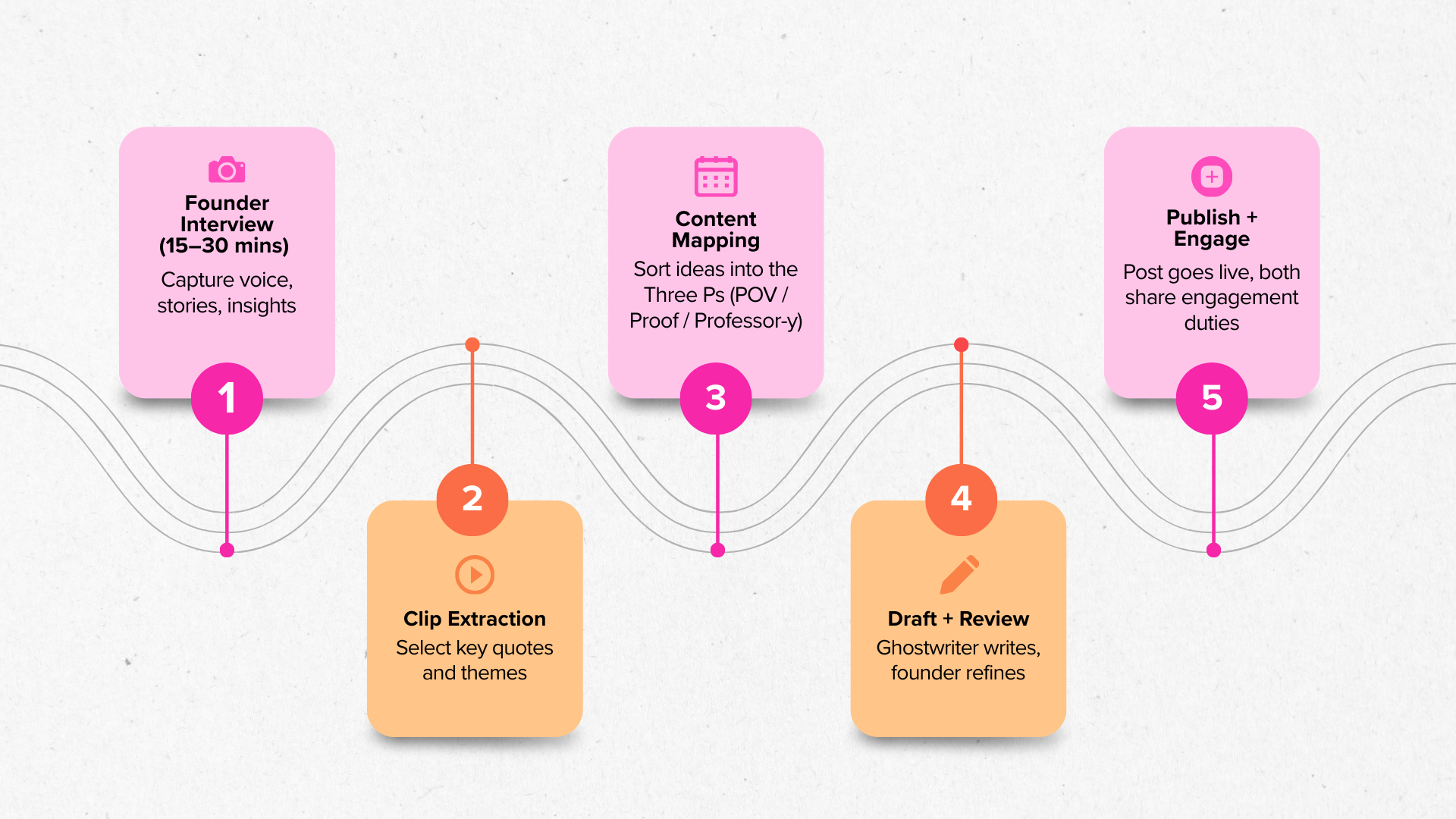
So, your LinkedIn ghostwriter knows your particular style and brand voice. Now what?
It’s time to craft content written with your LinkedIn founder personal brand. And for inspiration, there’s nothing better than kicking things off with a weekly 15 to 30-minute interview.
Rule: Focus on the Essentials
The interview part is straightforward enough, but it’s only the starting point.
For each interview, your LinkedIn ghostwriter has to narrow things down to the most usable clips or statements. These snippets will be the foundations for three types of content for your LinkedIn strategy.
One Interview, Three LinkedIn Content Pieces
Once the best parts of your interview are extracted, it’s time to repurpose them. We call these types of LinkedIn content the “Three Ps,” and they’re:
- POV Pieces: Writing in the first-person singular, your LinkedIn ghostwriter would have to play you for this one.
- Proof Pieces: Were there any successes noted in the interview? Turn them into case study-type posts for added social proofing.
- Professor-y Pieces: Anything insightful and informative should be repackaged as LinkedIn thought leadership content that educates readers.
Proof Without NDA Headaches
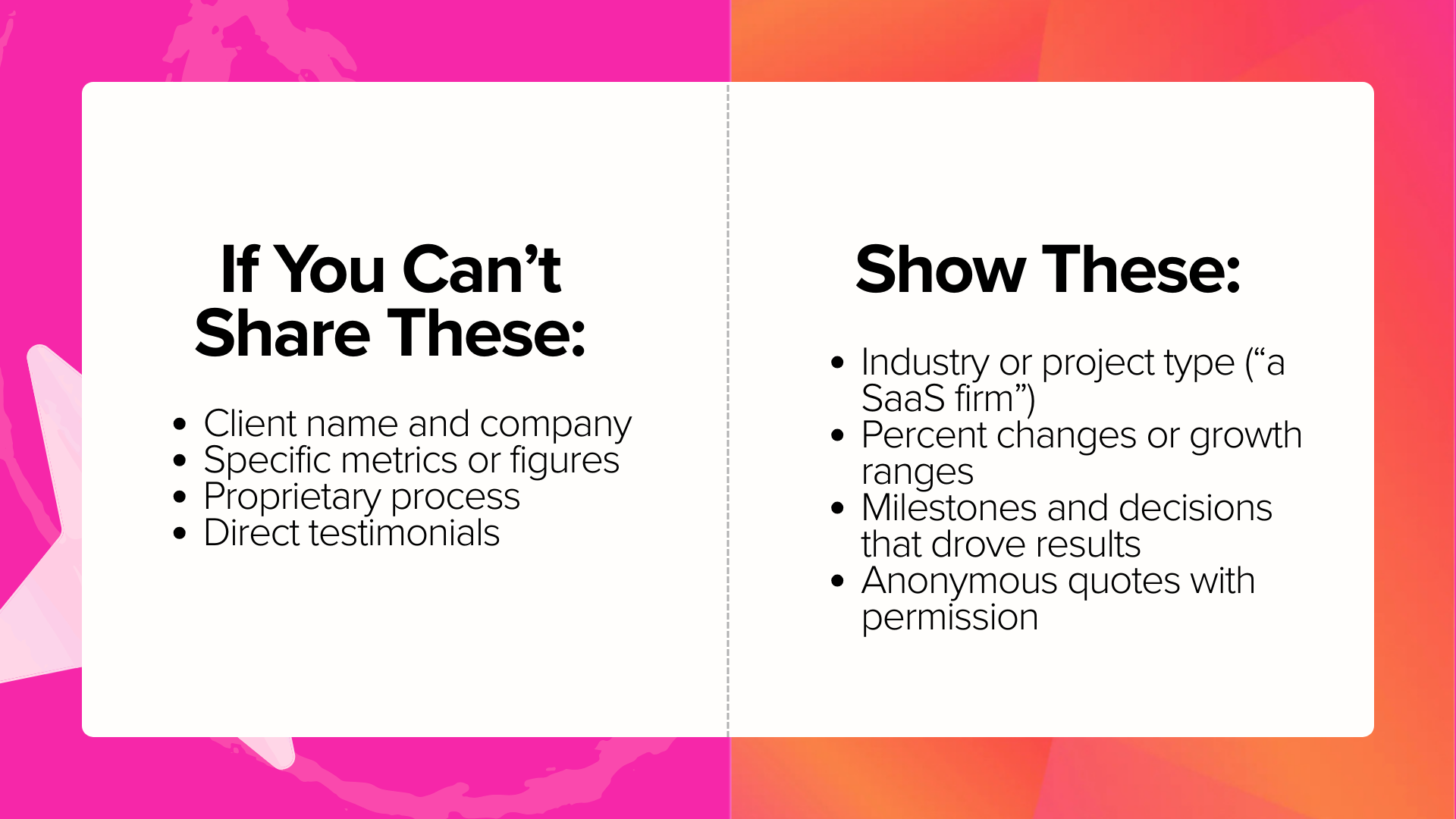
Of the three kinds of LinkedIn content we just talked about, proof pieces show how your ideas and offerings have changed the game for another person or business. So, all you have to do is drop some names in your case studies and success stories, right? Wrong!
Many of the businesses or clients you deal with may require an NDA, meaning you’ll have to keep mum about the specifics. Luckily, there are still ways for you to show off your transformative value as long as you strip identifiers and keep things general and outcome-focused.
How do you do it?
Use these “show-but-don’t-tell” pieces:
- Snapshots: Before-and-after metrics reveal growth trends.
- Process moments: Think of these as key turning points or decisions that shaped the results.
- Approved quotes: These are short, de-identified client remarks you’ve cleared for use.
Each adds credibility.
And do you know the best part? They do so without ever crossing legal or ethical lines.
Distribution and Community Management
There are two aspects to being visible on LinkedIn. Posting covers one half of the equation, but the other half is all about what happens after.
Timing
First, let’s talk about your posting timing and cadence.
Do you post every week or every other week? Whatever your answer is, be regular and consistent because your timing tells your readers when to expect your voice.
Engagement
Some will engage with your posts. When they do, your conversations should naturally shift to comments and DMs. It’s like guerrilla warfare — engage fast and timely, and you win.
Response: You or Your LinkedIn Ghostwriter?
And speaking of engaging fast, there’s going to be a time when you’ll have to directly respond — but be warned.
Your response can give you away, revealing to readers whether they’re interacting with you (the founder) or a LinkedIn ghostwriter. For the best results, leave the posts and surface-level interactions to executive ghostwriting on LinkedIn. Meanwhile, you’re in charge of the deeper conversations (like personal replies).
Strike the balance, and you’ll keep dialogue with your followers authentic while scaling your presence at the same time.
Keeping It (Your Executive LinkedIn Ghostwriting) Clean and Above Board
Let’s be clear — there’s nothing wrong with hiring someone to do your executive ghostwriting on LinkedIn. But even if LinkedIn has no rules against this, you do need to be authentic in your content.
In other words, your posts should come from your POV, personal insights, and experiences. It’s your LinkedIn ghostwriter’s job to express these and not create something out of thin air.
Fabrications Won’t Fool Your Followers
Made-up wins or exaggerated stories might be attention-grabbers, but all it takes is one follower to call BS.
Believe it or not, people are able to sense when something is off. For this reason, real insights drawn from your own path will always connect better than anything borrowed or inflated.
“Ay Ay Ay” AI Filler!
Let’s address the elephant in the room:
You’re thinking of using AI, aren’t you?
Whether it’s you or your ghostwriter, again, there’s no LinkedIn rule against this. But like overblown success stories and insights out of thin air, AI filler sticks out like a sore thumb. In fact, 65.9% of people can accurately detect writing, according to this one report.
If you’re using AI, take it from us:
Do you remember that “style bible” we talked about earlier? Feed it into the AI, and edit, edit, and edit.
Why “Growth Hacks” Miss the Point
When it comes to B2B content ghostwriting, it’s all about substance and value and not tricks or “hacks.” Consistency and honest reflection do more for your reputation than any so-called growth tactic.
Ethics Keep Your Engagement Engine Running
Lastly, there should be clear approvals before posting and a plan for edits or takedowns when needed. And above all, both you and your LinkedIn ghostwriter should be committed to staying truthful.
Measure the Metrics That Matter
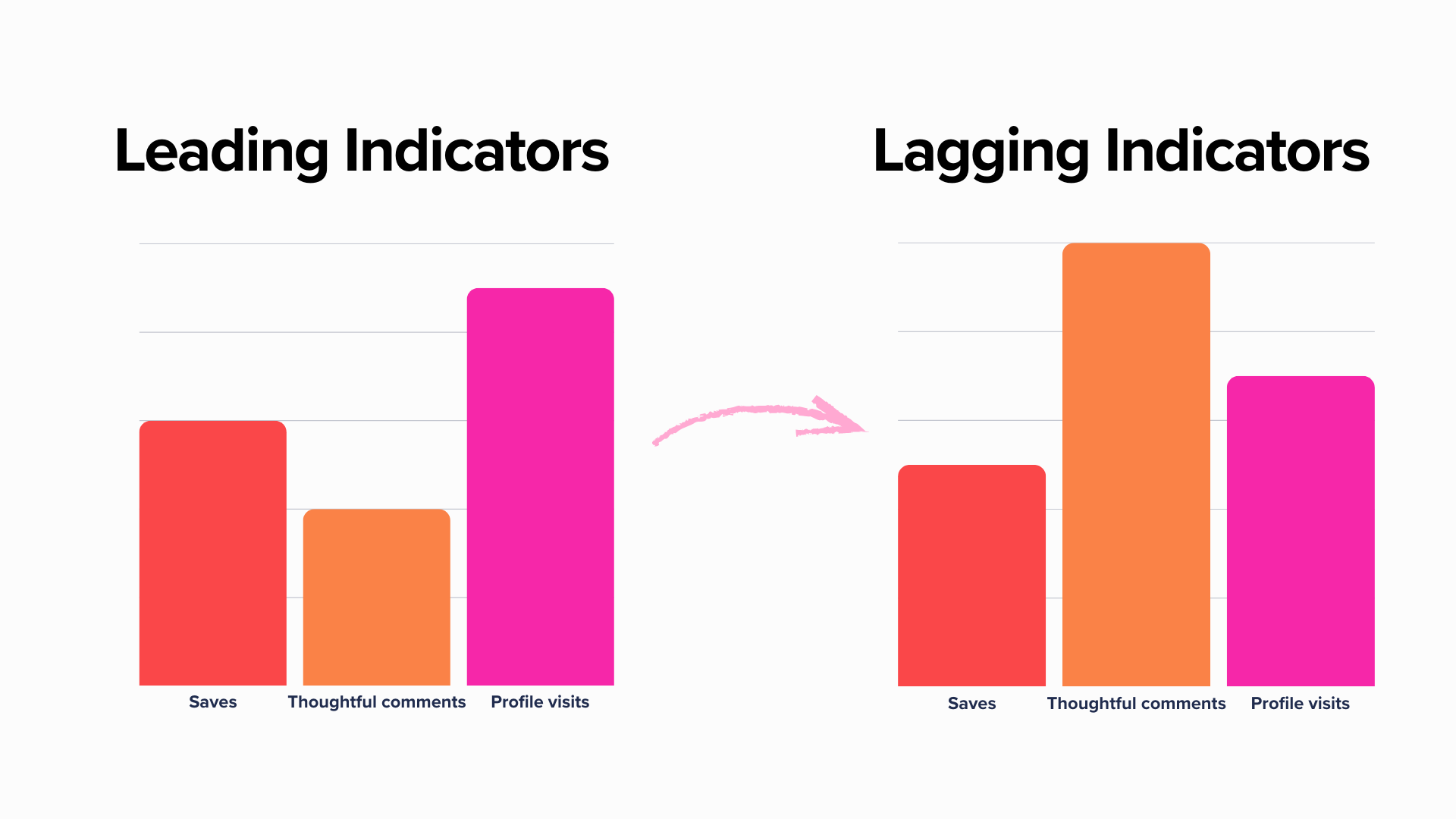
Likes are fine, but if you want a fuller picture of how your executive ghostwriting on LinkedIn is performing, look at:
- Saves
- Thoughtful comments
- Site or page visits
The higher these numbers are, the more likely it is that you’re reaching the right audiences. Over time, these signals can lead to real outcomes like warmer leads and more meetings.
As you look at the numbers, you’ll find that some topics spark conversations more than others.
Have a topic scorecard in place, and you’ll have a better idea of what subjects to expound on for better engagement and reach.
Executive Ghostwriting on LinkedIn Scales (Not Replaces) the Founder.
At the end of the day, you’re free to use every tool at your disposal to scale your personal brand on LinkedIn. Whether it’s a LinkedIn ghostwriter or AI, what’s important is that you keep things real, timely, and engaging.
If you need a team that can bring your voice to life on LinkedIn, consider a free consultation with us today. Also, check out our success stories to see how we’ve helped brands scale on LinkedIn and other platforms.
FAQs
How does executive ghostwriting on LinkedIn actually work?
It all begins with short and structured convos between you and your LinkedIn ghostwriter. In these chats, you need to go over:
- Ideas
- Stories
- Opinions
These will be the bases of your posts. From there, your ghostwriter drafts content, refines tone, and aligns everything with your voice before anything goes live.
Will the posts still sound like me?
Absolutely. The process is designed to capture how you think and speak.
But to be on the safe side, have a “voice bible” handy. This is your style guide that keeps phrasing, tone, and cadence consistent.
Only approve posts that meet the standards outlined in your voice bible.
How long does it take before I start seeing results?
It really depends on what results you’re after, but noticeable traction often shows up somewhere between the six to eight-week mark.
In any case, your first few weeks should be spent dialing in brand voice, tone, topic selection, and timing.